Capacity Building Digital Health Healthcare Inclusivity Research

Centre for Advanced Research for Rural Health Care Transformation

The Centre for Advanced Research (CAR) for Rural Health Care Transformation (RAHAT) aims to address inequities and improve access to quality primary healthcare in rural India by harnessing integrated digital health solutions. 

CCDC has been awarded the Indian Council of Medical Research grant in 2024 to establish the CAR for RAHAT.  Through this centre, CCDC aims to create a scalable, sustainable and equitable transformative rural model to improve quality of healthcare service delivery across five Indian states by strengthening capacity of medical institutes and leveraging digital technology. 

PROJECT LEADS

Prof. Dorairaj Prabhakaran

Executive Director, Centre for Chronic Disease Control (CCDC)

Prof. Sailesh Mohan

Deputy Director & Head-CVD Epidemiology, Centre for Chronic Disease Control

Dr Poornima Prabhakaran

Deputy Director & Head - Environmental Health, Senior Research Scientist

Dr Arun P Jose

Deputy Director & Head - BRIDGE Centre for Digital Health, CCDC, New Delhi

PROJECT EXECUTION

The Centre builds upon a network of medical colleges and their research infrastructure across the country. With this Smart Village Initiative, the Centre has the potential to transform healthcare delivery, empower communities, build research and practice capacity, and establish a robust rural health ecosystem.

The study is in full implementation phase from August 2026 across the six participating sites. This phase builds on evidence generated through the formative, co-design and vanguard phases. Findings from these phases helped identify training needs, research capacity gaps, facility readiness for digital health integration and community-level health needs.

  • At the institute level, Training of Trainers (ToT) workshops have been completed and trained faculty members are conducting cascade training within their respective institutions. The LMS-based modules and in-person practical activities for Research Methods, Health Systems Strengthening and Implementation Research, Digital Health, and Environmental Health and Sustainability are being rolled out across the institutes.
  • At the facility level, DigiSetu-enabled services have been rolled out at the health centres that enable creation of electronic health records, use the clinical decision-support system to provide standardised care and facilitate specialist tele-consultations.
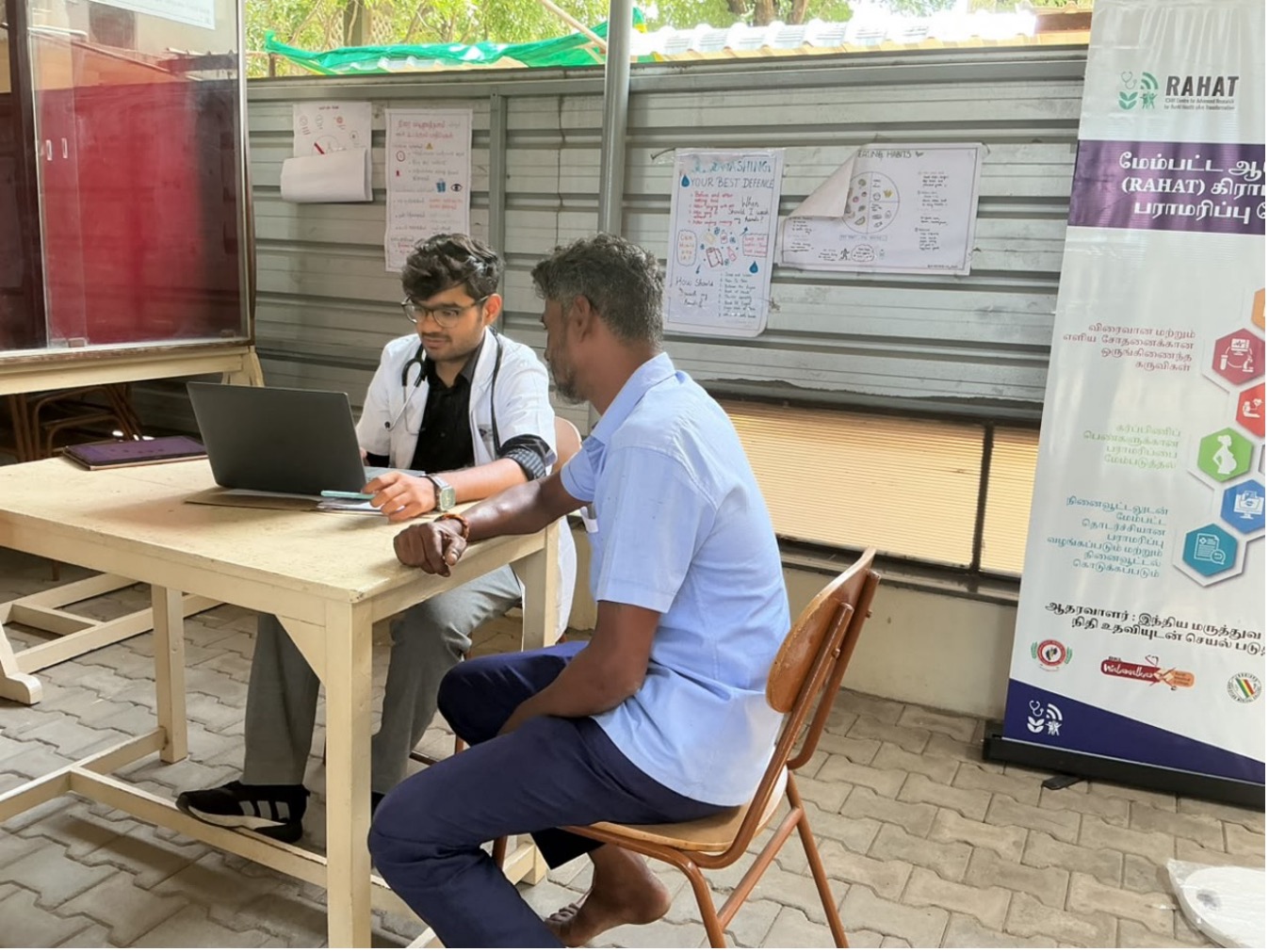
  • At the community level, outreach activities are being conducted to screen eligible adults for hypertension and diabetes, raise awareness, facilitate teleconsultations and referral when required.

Key highlights of the CAR

  • Capacity Building: Blended learning models in epidemiology, health systems strengthening, digital health, and environmental health and sustainability through short courses providing an immersive experience
  • Co-creation workshops for interventions
  • Health system redesign: Needs assessment through formative research;
    • Digital interventions such as assisted telemedicine integrated with decision support system and point of care diagnostic devices.
    • Recommendations for climate resilient health care service delivery
  • Community engagement for enhancing health seeking behaviour and improving digital literacy

Settings

  • The Centre’s efforts extend across different geographic regions, five Indian states, and six medical institutes.
Slide
Slide
Slide
Slide
Slide
Slide
Slide
Slide
Slide
Slide
Slide
Slide
Slide
Slide
Slide

IMPACT

The baseline and formative phase, co-design and vanguard phase are complete. The output presented below demonstrates the progress achieved across these phases-

  • Community-level baseline assessment: During the baseline phase ~4,500 households were approached of which 3,960 households were enumerated with 16,990 individuals. Of which detailed baseline assessment was collected for 2,028 individuals. These data provided evidence on healthcare access, service utilisation, health-seeking behaviour, treatment compliance, digital health literacy and hypertension and diabetes care cascades.
  • Formative qualitative evidence: A total of 57 formative qualitative data-collection activities has been completed, including 34 in-depth interviews, 17 focus group discussions and six MRU/RD situational analyses. These findings helped identify institutional training needs, research capacity gaps, facility readiness requirements, community priorities and contextual barriers and enablers for implementation.
  • Facility-level assessments: A total of 133 patient exit interviews were completed to understand referral experiences, service utilisation and patient experience. In addition, 221 antenatal-care assessments were completed at two sites to assess the quality and completeness of routine ANC services.
  • Vanguard phase – During the vanguard phase, Training of Trainers (ToTs) workshops and pilots of in-person capacity-building activities were conducted. Facility-level teleconsultation workflows and community camp activities were also tested and monitoring data were reviewed to identify implementation bottlenecks and guide iterative refinement before full-scale implementation.
  • Capacity-building outputs: Two centrally conducted Training of Trainers workshops covering four capacity-building domains have been completed, training 68 faculty members. The Trained faculty members are now conducting cascade training within their respective institutions.

Centre for Chronic Disease Control © 2026 All rights reserved.