The GEOHealth HEALS study aims to conduct exposure assessments including a range of air pollutants PM2.5, nitrogen dioxide (NO2) and ozone (O3), and extremes of temperature to assess the exposomes at fine spatiotemporal resolutions across different locations in India (Delhi, Chennai, Sonipat, Vizag, Pune, Hyderabad and Bikaner.
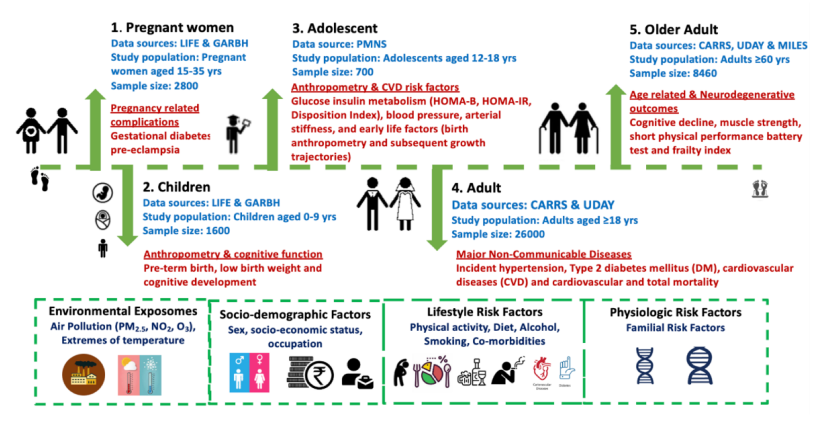
The study will evaluate the composition of PM2.5 in these locations and measure real-time exposures in a subset of the participants at different sites. These exposomes will be related to a range of chronic noncommunicable diseases across the life course using inter-digitating cohorts. This will be achieved by leveraging existing pregnancy, children, adult, and older adult cohorts across India. This will help us systematically assess the vulnerable populations across pregnancy, infancy, childhood, adolescence, adult, and older adult groups.
The study will also address how environmental exposomes interact with gender, socio-economic status, rural-urban settings, and pre-existing illnesses in impacting health outcomes.
Exposure Assessment
Aim1 | Assess environmental exposomes (PM2.5, NO2, O3, and extremes of temperature) for Delhi, Chennai, Sonipat, Vizag, Pune, Hyderabad, and Bikaner by:
- Developing machine learning-based predictive models at fine spatio-temporal resolutions (spatial: 100m-1km, temporal: daily) for each exposure at each location.
- Developing predictive models for speciated PM2.5 (metals, organic and elemental carbon), using ground monitoring-based measurements of PM2.5 components, ambient PM2.5, meteorology, and land use patterns, across the study locations.
Aim 2 | Carry out real-time personal environmental exposome measurements to (1) obtain PM2.5, NO2, O3, and temperature exposure profiles at individual levels, (2) assess the extent of exposure error between personal and modeled exposome levels, and (3) evaluate exposure inequalities among various socio-economic and demographic groups.
Health Association Studies
Aim 1 | Assess associations between selected exposures and chronic non-communicable diseases across the life course using existing cohorts (as described below)
- In pregnancy & child cohorts, we will retrospectively and cross-sectionally study the effects of exposomes on pregnancy related complications (gestational diabetes, pre-eclampsia) and adverse birth and childhood outcomes (pre-term birth, low birth weight and cognitive development).
- In adolescent cohorts, we will retrospectively study the effects of exposomes on the glucose-insulin metabolism (HOMA-B, HOMA-IR, Disposition Index), blood pressure, arterial stiffness, and whether early life factors (birth anthropometry and subsequent growth trajectories) modify this relationship.
- In adult cohorts, we will study the short, intermediate, and long-term effects of exposomes on incident hypertension, Type 2 diabetes mellitus (T2DM), cardiovascular diseases (CVD), and cardiovascular and total mortality.
- In older adult and aging cohorts, we will study the short, intermediate, and long-term effects of exposomes on age-related and neuro-degenerative outcomes (cognitive decline, muscle strength, short physical performance battery test, and frailty index).
The present study will also explore the potential effect modification of the above associations by sex, socio-economic status (wealth and education), rural-urban settings, and pre-existing illnesses in the adult cohorts to identify susceptible groups, help design interventions, and inform policy actions.
 Next Project